
Play together · 7 min read
12 storytelling games to play with your child
These games are invitations to make something together, not competitions. Start with one. A parent and child can play every game; a small group can pass the next turn around.
Try this together
One little idea for right now
Try ‘One sentence each’: ‘A tiny gardener found a staircase inside a seed.’ Your child adds the next sentence—or makes the sound of the door opening.
- Time to play
- 2–10 minutes per game
- What you need
- Mostly just your voices. Optional paper, toys or household objects.
Games with nothing to prepare
1. One sentence each · 3 minutes
For two or more. No materials. Take turns adding a sentence about the same character. After a few turns, ask together how to pause or end. Short turns leave room for everyone.
‘The lift went sideways.’ ‘It stopped at a bird’s kitchen.’
2. The sound comes first · 2 minutes
For two or more. No materials. One player makes a sound; the next says who made it and why. Swap roles. Pointing or acting can replace the spoken answer.
‘Plip, plip!’ ‘The cloud is learning to tap-dance.’
3. Wrong-way fairy tale · 5 minutes
For two or more. No materials. Choose a familiar story and change one rule. Keep the rest recognisable while you discover the consequences. Let each player choose one change.
‘What if the wolf wanted directions to the library?’
4. Someone else’s shoes · 5 minutes
For two or more. No materials. Retell a small invented event from two viewpoints. The first player is the visitor; the second is the place or object they visited.
‘I climbed the hill.’ ‘I’m the hill. Your boots tickled me.’
Games with things already nearby
5. Three-object adventure · 5 minutes
For two or more. Choose three safe, everyday objects. Decide which is a character, which suggests a place and which causes a problem. Tell a short adventure connecting all three.
A spoon is an explorer; a cushion is an island; a ribbon is a river that won’t stay still.
6. Toy interview · 5 minutes
For two. Use a toy or a drawn face. One player asks three questions; the other answers as the character. Swap. Ask about a wish, a worry and something in its pocket.
‘Why is your pocket jingling?’ ‘I’m delivering bells to the moon.’
7. The missing thing · 5 minutes
For two or more. Look at a safe nearby object, then cover it. Invent why it disappeared and where it went. Reveal it and decide what changed during its journey.
‘The sock went to visit its grandmother. It came back smelling of cinnamon.’
8. A map on the floor · 10 minutes
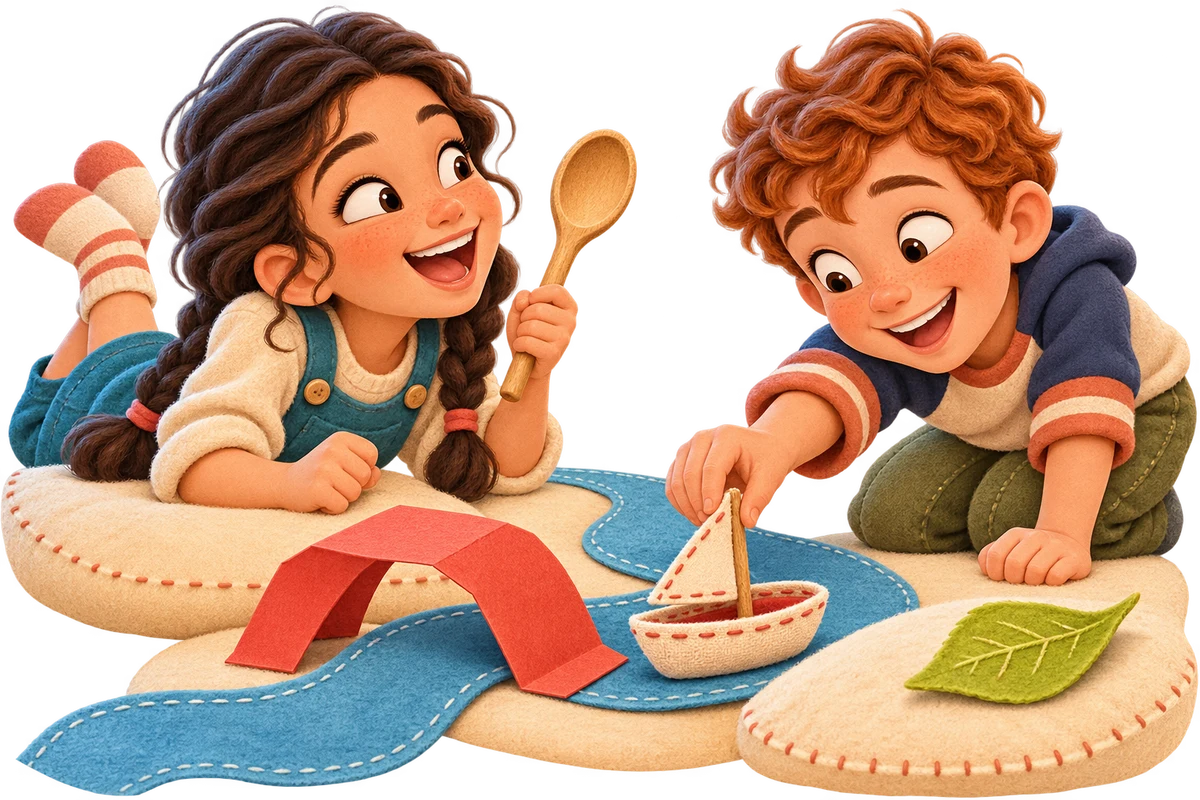
For two or more. Use three cushions or pieces of paper as landmarks. Name each place. Walk a toy between them, stopping to invent one event at every landmark. Keep the route clear and easy to move around.
‘This is Whisper Hill. To cross it, we have to tell the stones a secret.’
Games for pencils, gestures and big ideas
9. Pass the doodle · 5 minutes
For two or more. Paper and a pencil. One person draws a shape; the next adds a feature and names the new character. Give it one wish, then tell how it tries to get it.
A squiggle becomes a snail with a lighthouse on its shell.
10. Three frozen moments · 5 minutes
For two or more. No materials. Make a still pose for the beginning, middle and end of an adventure. A seated hand gesture works too. Another player narrates, then the actors can revise the telling.
Hands holding a parcel; hands surprised by a squeak; hands building a little bed.
11. Postcard from impossible · 10 minutes
For two or more. Optional paper. Imagine visiting a place that cannot exist. Draw or describe the view. Tell someone at home one thing that happened there and one thing you will bring back.
‘Greetings from Tuesday Island. We found a shop selling yesterday’s weather.’
12. Two endings, one beginning · 5 minutes
For two or more. No materials. Start with the same small problem. Each person offers a different next choice and follows it to an ending. Compare what changed without choosing a winner.
Dumpling finds a locked gate: in one telling she looks for the key; in another she asks the gate what it wants.
Keep it playful for everyone
If a game stalls, offer two choices or take one short turn yourself. If it gets too busy, return to a single character and one place. You can stop mid-story and keep the best line.
For children who prefer not to speak, accept a picture, a gesture or a selected object and narrate only what they agree to. With mixed ages, let older children offer choices rather than decide for younger players. There is no correct amount of vocabulary or detail to reach.
For bedtime, choose a quiet voice game and a familiar place. Save lively acting for another moment. No screen is needed for any of these games.
A few parent questions
Which game is easiest to start with?
Try a sound or one sentence each. Both need no materials, and a turn can be very short. Choose according to your child’s interest rather than an age label.
What if one child takes over?
Agree on one choice or sentence per turn and let anyone pass. Give the next decision explicitly to another player: ‘You chose the friend; now your sister chooses the place.’