
Why it matters · 5 min read
Why storytelling matters for children
When a child invents a character and you ask what happens next, you give them a place to try out ideas with someone listening. The value of the moment does not depend on producing a polished book.
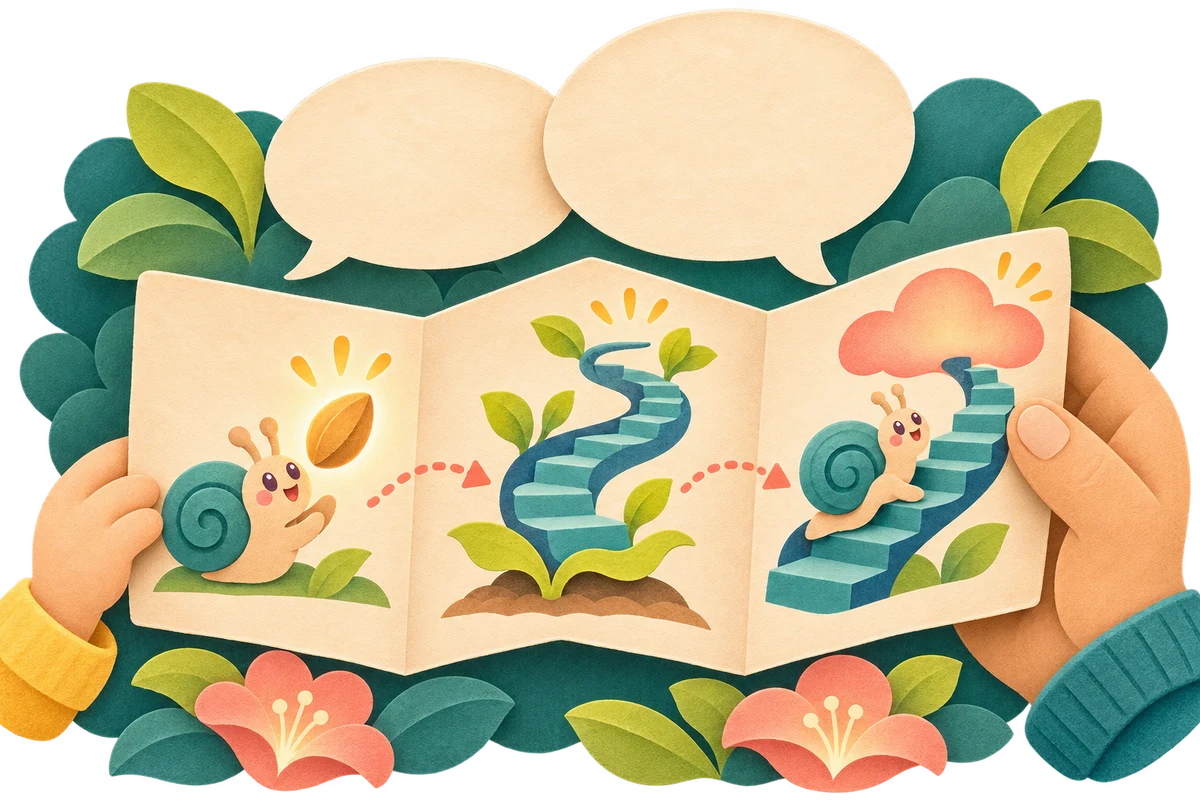
Try this together
One little idea for right now
Ask your child to invent a visitor at the door. Listen to one thing the visitor wants. Repeat it back and ask what they might try next. Notice the exchange, rather than scoring the result.
- Time to play
- One small conversation
- What you need
- A listener and an idea. No app required.
What the evidence can—and cannot—tell us
NAEYC describes storytelling as a way for preschoolers to encounter words and prepare for reading and writing. That supports making room for stories at home; it does not establish outcomes for FableBunch.
A research review by Lillard and colleagues warns against treating pretend play as a proven unique cause of broad developmental benefits. Children’s experiences differ, and playful storytelling is not the same as a formal educational intervention.
The examples below describe opportunities to practise during a shared activity. They are not promises of improved intelligence, school results, mental health or any measurable gain from using our app.
Putting an idea into words
A child may try a description, hear you ask what it means and choose another way to explain. You can make the idea more visible without taking ownership: ‘So the bridge bends when someone whispers?’
Try naming one useful word in context: ‘The light is dim—only a little bright.’ Then return to the story. The activity need not become a vocabulary quiz. A child using gestures, pictures or another language can participate too.
Following a sequence and a choice
A story gives you something concrete to put in order: first the seed arrived, then it grew a staircase, then someone climbed it. ‘What happened before that?’ and ‘What changed after the choice?’ are invitations to connect events.
Try drawing three boxes. Let your child choose one moment for each. If the order changes, ask them to show their version. There is no requirement to reach an adult model of a perfect beginning, middle and end.
Listening and making room for another view
Taking turns means responding to an idea someone else added. A character can also give you a playful question about perspective: ‘Duck wants to cross. What might the bridge want?’ The story offers a place to explore possible answers without declaring one correct emotion.
Keep feelings optional. A child does not have to reveal a personal worry through a fictional character. If a topic feels uncomfortable, change it or stop. Stories are not a substitute for professional support when a child needs it.
Making an idea feel like theirs
Invite a decision that matters: the friend’s name, an unusual rule, the next attempt. Ask before changing it. You can notice the choice specifically: ‘You decided the lighthouse needed a friend instead of a new bulb.’
Keep a drawing or a line if your child wants to. Returning to a familiar invention can be enjoyable; it does not need to become a project with milestones. Some children prefer listening, real-life stories or play without narration. Offer rather than require.
Where a tool fits
Paper, voices and toys are enough. FableBunch offers a place for a parent to describe family-created characters and worlds and make stories from those ideas. Read generated text together, check that it fits your family and choose what to keep.
The app is not a developmental assessment or a clinically validated intervention. The useful question for a family session is simpler: did your child have room to contribute, and did you enjoy making something together?
A few parent questions
Does storytelling make children more creative?
It gives children a chance to invent and try alternatives. That is different from proving a general increase in creativity. We do not claim that FableBunch causes a developmental improvement.
Is making up stories better than reading books?
You do not need to choose a winner. Read a book, talk about a picture or invent something together according to interest. These can be different enjoyable parts of family life.
Sources & further reading
The activities are original FableBunch ideas. These sources provide background; their publishers do not endorse or evaluate our app.
- NAEYC · Everyone Can Be a Storyteller
Family guidance on preschool storytelling, vocabulary and early literacy.
- Lillard et al. · The impact of pretend play on children’s development (2013)
A research review cautioning against strong causal claims for pretend play.